

Location: Biodiesel
The Oilybits Guide to making Biodiesel
Although times have changed greatly in the world of alternative fuels, Oilybits continues to support the customers who were loyal to us in the mid-nouhgties, when we entered the market with our range of altetnative-fuel production technologies and vehicle conversion kits. Please find below legacy information from our extensive amateur research into Biodiesel production, we hope you find it useful.
At this time Oilybits no longer sell Biodiesel Processors, however, we do sell all the hardware seperately to build your own biodiesel processor, and we also sell a wide range of centrifuges which have become popular for purifiyng other alternative fuels, such as WVO (Waste Vegetable Oil), UCO (Used Cooking Oil) and WMO (Waste Motor Oil), these can all be found in the left menu under 'Centrifuges'.
IMPORTANT: This information is provided in good faith and to the best of our knowledge is accurate, however it is entirely your own decision as to whether you use any part of it, and entirely at your own risk if you choose to do so. We do not accept any liability whatsoever should this information be used or misused in any context. Unfortunately we are not able to explain the process of making biodiesel on an individual basis
Copyright Oilybits Ltd. 2007, not to be reproduced.
Making Bio Diesel
The process of producing Bio Diesel can be as simple or as involved as you want it to be, though the more effort you go to, the more oil you will be able to convert to biodiesel, and the better quality biodiesel you will have as a result.
There are three popular ways of producing biodiesel domestically, these are listed below in order of difficulty, least to most difficult.
Oilybits use method 3 on every batch irrespective of whether titration is high or low, this is because the Acid esterifies any animal fat which may be in the fuel (which KOH / NaOH alone, cannot), which would cause a massive problem to the type of vehicle we run on it otherwise
Method 1 - Single Stage Base Reaction, using Sodium Hydroxide NaOH, or Potassium Hydroxide KOH
A popular entry level method, which will produce biodiesel from low FFA feedstock, to around 90% conversion. Not possible to achieve EN14214 using this method.
- Source Oil
- Strain Oil to 400 Microns
- Heat Oil to 100°c Bubble Dry until no more steam evaporates and Oil is clear, maintain 100°c throughout
- Allow oil to cool to 55°c and maintain 55°c for the Base stage
- Titration Test of Oil
- Prepare Methoxide
- Add Methoxide to Oil
- Mix Methoxide with Oil (@1 Hour)
- Settle Glycerol (@15 Mins)
- Drain off Glycerol
- Perform 3/27 Test to determine if any Triglycerides (unreacted vegetable oil) remains in the biodesel. If they do, then follow "Re-Processing" instructions below
- Wash Bio Diesel with Water or Dry Wash Media
- If washed with Water, Heat Oil to 80-100°c, and Bubble Dry until no more vapor , Maintain 80-100°c throughout
- Test Bio Diesel Quality
- Filter Bio Diesel
- Mix In Performance Additives (Optional)
Method 2 - Two Stage Base Reaction, using Sodium Hydroxide NaOH, or Potassium Hydroxide KOH
The low volume commercial way to do it, this method will produce biodiesel from low FFA feedstock, to 100% conversion, potentially meeting EN14214
- Source Oil
- Strain Oil to 400 Microns
- Heat Oil to 100°c Bubble Dry until no more steam evaporates and Oil is clear, maintain 100°c throughout
- Allow oil to cool to 55°c and maintain 55°c for the Base stage
- Titration Test of Oil
- Prepare Methoxide
- Add 80% of Methoxide Mix to Oil
- Mix Methoxide with Oil (@1 Hour)
- Settle Glycerol (@15 Mins)
- Drain Glycerol
- Add remaining 20% of Methoxide to Oil
- Mix Methoxide with Oil (@1 Hour)
- Settle Glycerol (@15 Mins)
- Drain Glycerol
- Perform 3/27 Test to determine if any Triglycerides (unreacted vegetable oil) remains in the biodesel. If they do, then follow "Re-Processing" instructions below
- Wash Bio Diesel with Water or Dry Wash Media
- If washed with Water, Heat Oil to 80-100°c, and Bubble Dry until no more vapor , Maintain 80-100°c throughout
- Test Bio Diesel Quality
- Filter Bio Diesel
- Mix In Performance Additives (Optional)
With this method you can also Bubble Dry the first batch of Glycerol Drained in a seperate vessel to recover methanol if desired.
Method 3 - Single Stage Acid-Base Reaction, using Sulphuric Acid, and Potassium Hydroxide KOH
The professional way to do it, this method will produce biodiesel from virtually any suitable feedstock including Palm, Tallow and Lard, to 100% conversion, potentially meeting EN14214
- Source Oil - Can include animal and solid fats and oil with high FFA and resulting high titration values
- Strain Oil to 400 Microns
- Heat Oil to 100°c and bubble dry until no more steam evaporates and Oil is clear - VITALLY IMPORTANT
- Allow oil to cool to 55°c and maintain 55°c throughout Base stage - VITALLY IMPORTANT
- Measure out Methanol equal to 17% of the volume of UCO - Example 100 Litres Oil = 17 Litres of Methanol
- Measure out Sulphuric Acid, use 1.5ml per 1L of UCO, Example 100 Litres of UCO = 150 ml of Sulphuric Acid required), add the Suplhuric Acid to the methanol, and then add the mixture to the Oil
- Mix everything together for 2 hours @ 55-60°c
- Leave overnight to cool for 12 hours, or for best results, 24 hours, the longer it is left the lower the Titration will drop (to its theoretical minimum titration)
- Heat Oil to 55°c
- Titration Test of Oil
- Prepare Methoxide, calculating KOH and Methanol based on the original volume of UCO in the tank, LESS any litres of sludge that have been drained, and using 3% methanol by volume of the original amount of UCO - Example 100 Litres of UCO = 3 Litres of Methanol, PLUS enough methanol to make this sufficient to dissolve the required mount of KOH in, we recommend around 3-4L of methanol to dissolve 1-1.5kg of KOH in to. Dont worry that the Methanol volume is a little un-scientific, remember it is only important to add "enough" methanol, it doesnt matter if you add a little too much, too much is better than too little.
- Add Methoxide to Oil
- Mix Methoxide with Oil (@1 Hour)
- Settle Glycerol (@15 Mins)
- Drain off Glycerol
- Check PH using Bromothymol Blue or PH Paper, PH 7 is required. If PH is not 7, wash with plain water, or water containing Acetic Acid to correct PH
- Perform 3/27 Test to determine if any Triglycerides (unreacted vegetable oil) remains in the biodesel. If they do, then follow "Re-Processing" instructions below.
- If PH 7, Wash Bio Diesel with Water or Dry Wash Media
- If washed with Water, Heat Oil to 80-100°c, and Bubble Dry until no more vapor , Maintain 80-100°c throughout
- Test Bio Diesel Quality
- Filter Bio Diesel
- Mix In Performance Additives (Optional)
This method allows oil with a very high FFA to be converted to biodiesel without using copious amounts of methanol or KOH or risking failure of the Glycerol to separate, in principle, the acid treatment is used to reduce the titration result to a more acceptable level. Using Sulphuric Acid as a catalyst with Methnanol "Esterifies" all of the Triglycerides in the UCO, this also has the effect of increasing yield, by converting more of the UCO to biodiesel during the following "transesterification" process.
Shown below, Stages of Method 3: Phial 1) UCO after drying, Phial 2) Acid Esterified, note floating methanol, Phial 3) Crude Biodiesel, Phial 4) Washed & Dried Biodiesel

Reprocessing Instructions for biodiesel with a high percentage of unreacted vegetable oil (Triglycerides) This instruction is written to be followed immediately after draining of glycerol from crude biodiesel, whilst the biodiesel is still warm and has not been washed
- Heat Oil to 55°c
- Perform 3/27 Test, from this calculate approximate amount of unreacted oil in the batch in Litres
- Titration Test of Oil
- Prepare Methoxide - calculate KOH amount based on the quantity of unreacted oil in the biodiesel, use only enough methanol to facilitate mixing of the KOH, amount is unimportant
- Add Methoxide to Oil
- Mix Methoxide with Oil (@1 Hour)
- Settle Glycerol (@15 Mins)
- Drain off Glycerol
- Wash Bio Diesel with Water or Dry Wash Media
- If washed with Water, Heat Oil to 80-100°c, and Bubble Dry until no more vapor , Maintain 80-100°c throughout
- Test Bio Diesel Quality
- Filter Bio Diesel
- Mix In Performance Additives (Optional)
Neutralisation Instructions if you add too much NaOH / KOH If you get your calculations wrong, even by a relatively low margin, you will end up with a tank of what is commonly described as 'marmalade' - a dark orange, homogenous mixture with no evident glycerol separation. Do not despair... but first, and most importantly, if youre using NaOH DO NOT LET IT GO COLD! What you need to do is keep the mixture @55°c to prevent it from going solid, and begin to add Acetic or Phosphoric Acid NEAT to the mixture with the pump running - if you dont have this, then use household Vinegar - it is best to experiment with a small sample to determine te amount of vinegar you will need - it could be a lot. Keep adding the Acid/Vinegar until the mixture splits, it will do this immediately as the PH approaches PH7, maybe only a few minutes after adding the acid, the glycerol will be seperated and the biodiesel will have gone very light and thin, once youve done this, drain glycerol and proceed with washing as normal
EN14214 - What is this?
EN14214 is the European Standard for B100 Biodiesel. B100 means the fuel is 100% Biodiesel, 0% Mineral Diesel.
EN14214 specifies maximum levels of contamination allowable for B100 to be sold commercially, and in many cases, for vehicle manufacturers warranties to cover use of it in their engines. It is worth noting that this standard is a very high standard, and most vehicles will run fine on fuel of lesser quality, indeed some vehicles run on waste vegetable oil, and waste engine oil, but if you want to be on the safe-side, then this is the grade to achieve
To view a typical EN14214 fuel quality assessent, please download test report HERE, this is a sample produced using a standard Oilybits 120L Kit, plus air pump, and dessicant vessel, and produced using 'Method 2' with Water Wash, and 5% Prewash.
It is worth noting, that whilst EN14214 is the standard manufacturers should be producing fuel to, in our exprience, most, if not all low volume commercial producers do not maintain this level of quality as they do not have the means to remove methanol from the finished biodiesel... methanol can only effectively be removed by water washing with enormous quantities of water, or by heating to 60+ and bubble drying / vacuum distillation.
| Requirements | Test Method | EN14214 Limits | Units |
| Ester Content | EN 14103 | Min 96.5% | %m/m |
| Density @ 15°c | EN ISO 3675 / EN ISO 12185 | 860 to 900 | kg/m3 |
| Viscosity @ 40°c | EN ISO 3104 | 3.5 to 5.0 | mm2/s |
| Water Content | EN ISO 12937 | Max 500 | mg/kg |
| Acid Value | EN 14104 | Max 0.50 | mg/KOH/g |
| Methanol Content | EN 14110 | Max 0.20 | %(m/m) |
| Flash Point | ISO 3679 | Above 101 | °c |
| Cold Filter Plugging Point | EN 116 | Climate Related |
5% Pre-Wash (Optional with all processes above)
A Pre-Wash is a method of washing out soap with very little water, prior to the draining of glycerol. The upside of this method is that you use less water to wash your fuel, but the downside is that you cannot recover methanol from either the biodiesel, or the glycerol, once water has been added to the mixture.
How to pre wash - once you have mixed your methoxide with the UCO for 1 hour, add 5% (of the volume of UCO) of Water to the tank, circulate for 15 minutes, then proceed to settle and drain Glycerol as normal. Subsequent water washes will be much cleaner and thus the total amount of water required to wash the batch will be reduced
"5% Pre-Wash" is not to be confused with the "Glycerol Pre-Wash" which is explained below, under "2. Purify UCO"
1. Source WVO
The key to quality Bio Diesel, is quality ingredients, otherwise known as 'Feedstock'
The best quality feedstock is 'SVO' (Straight/New Vegetable Oil) but with the cost of SVO being so high this makes it a completely unviable option, therefore 'WVO' (Waste Vegetable Oil) or 'UCO' (Used Cooking Oil) is the obvious second choice. From here on we will talk about making biodiesel from UCO
UCO should, ideally, be from a source that does not use Hydrogenated Vegetable Oils, Palm Oil, Tallow, Lard, Dripping, or any other kind of solid substance in their fryers. Using a liquid UCO will greatly ease your process and the 'Cloud Point' of your biodiesel will be more appropriate for the temperatures in the U.K. UCO should be a transparent liquid at 20 celcius, of a similar colour to honey, however it can be of any colour. Some UCO is very dark and some is very light, the colour can be dependent upon the cooking temperature or colour of the food cooked in it. VERY dark, or black oils, will usually titrate very high - above 10ml, and these oils really need to be converted using the Acid-Base Reaction.
UCO is often supplied by restaurants in the containers it is supplied to them in, these are most commonly 15L Yellow Snap Lid Buckets, 20L Steel Drums, or 20L flimsy LDPE screw cap containers, it can help to identify the type of oil you have been given by the information on the buckets. Rapeseed Oil is the most commonly available oil, and best oil to use due to its low 'Cloud Point' (Solidification Point). This desirable property will be transferred to the finished Bio Diesel. Cloud point can be further reduced by the type of Catalyst you use in your process (Potassium Hydroxide is the best), and by Coldflow Additives which are the final line of defense against freezing fuel, alternatively biodiesel can be mixed with any ration of petroleum diesel to further reduce its cloud point.
To collect UCO some people simply collect the containers and taken them away, but others, conscious of the fact that they then have to dispose of the containers, just take the oil, leaving the restaurants to put the empty containers in their own bin. Oil can be sucked out of drums and barrels using only one particular type of pump - a "Flexible Impeller Pump". This type of pump has a rubber impellor which bends as it rotates to displace liquid from one side to another, and due to this flexibility it can handle large particle debris in the oil without it damaging the pump. Oilybits supply a number of Flexible Impeller Pumps for Waste Oils.
2. Purify UCO
Purifying UCO can be a very messy business, we recommend you always use overalls, protective goggles / face mask and a pair of latex, PVC, vinyl (or alternative) rubber gloves. UCO can smell extremely rancid, sometimes like vomit, this is caused by fermenting (rotting) meat, vegetable, and water particles in the oil and the smell will dissipate as the oil is cleaned. Make sure you do not get any UCO in your mouth as it can cause food poisoning, we know of a number of customers who have experienced this, though they do still make Bio Diesel regardless - they consider the saving is worth the pain!
Most impurities in UCO will settle very quickly if the fuel is warmed, then left to cool and settle in a room at around 20°c. To settle impurities in the most efficient manner you will need a Conical Bottomed Tank. A Conical Bottomed Tank allows all major impurities to settle to the narrow bottom of a cone, where they can then be drained out effortlessly via a Valve in the bottom of the cone
You can aid the settling process (if you require greater speed of UCO purification) by removing very large particle contamination such as chips, meat, and batter before the oil is poured into the Conical Tank, this can be done very efficiently by heating the oil and then passing through Washable Nylon Monofilament Bags, from 800 to 200 micron, or, if your fuel is fairly clean and above approx 15°c, a 400 Micron Washable Bag on itself should be adequate. We always recommend that oil is strained, as from experience it is unbelievable how much hassle a Sausage blocking the bottom valve can be, when your tank is full up with 120L of filthy UCO!
After the UCO has settled you will see a thick layer of light coloured creamy debris at the bottom of the tank, this will be food particles, water, and Animal Fats, carefully drain this off via the bottom valve and discard completely, or pour into another vessel for longer term standing. Animal fats are more difficult to convert to biodiesel, and have a very high cloud point of 30-60°c, so unless you are using your biodiesel only in a very hot climate (over 30°c at all times) they should be drained and disposed of as waste. If they are left in the mix, then the end result post-transesterification will show contamination in your biodiesel, until the temperature is above the cloud point of the animal fat molecule with the highest cloud point. Molecules of animal fat which are below their cloud point will appear like snow - just like those kids "snow globes" which you shake and watch the snow "fall".
Some UCO may contain saturated water, and it is important this is removed as it will lead to excess soap being produced and an incorrect (low) amount of catalyst being available to the reaction if it is not removed. Saturated water will present itself in the form of cloudiness which never settles out. The best way to remove this is to heat the oil to around 80-100c, and, by attaching an air line to the bottom of the tank, pass bubbles up through the oil to drive out the moisture. When the oil becomes clear, the water has been dissipated and the oil can be transferred to the reactor ready for transesterification
Another, athough in our opinion unnecessary stage of filtration could be either "Depth Filtration" using a housing with disposable elements, such as our 10" Housings or 20" Housings, or if you want to eliminate waste filtration media, then a Centrifuge could be utilised, such as our Raw Power Centrifuge. Generally a Coarse Filter Bag (400 micron), followed by settling in a Conical Tank, and heating & bubbling to drive out water will be adequate
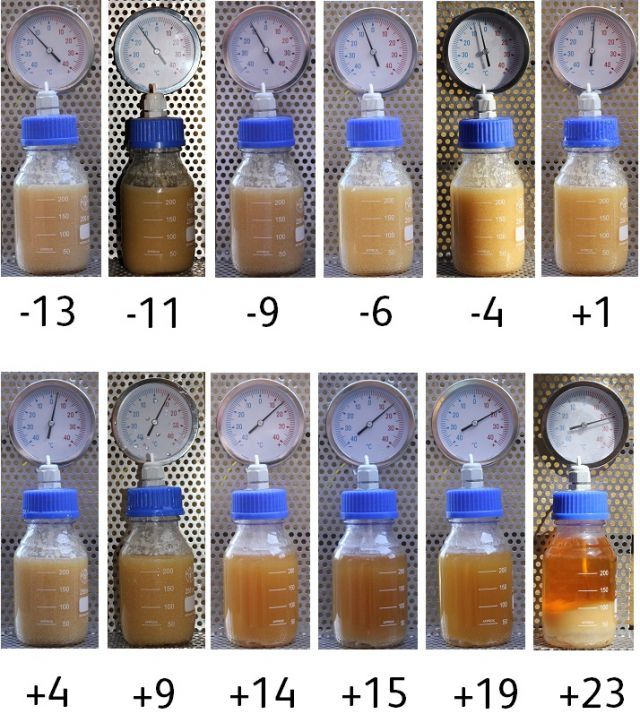
Shown Below, typical UCO sample collected during winter. This sample is a mixture of Rapeseed Oil, Palm Oil, Animal Fat, and Water. At +15 it begins to seperate and form layers, and at +24 it has completely seperated into distinct layers, from bottom, water (clear), animal fat (white), liquid Palm Oil mixed with rapeseed oil (honey colour). These characteristics will be transferred to the biodiesel it is made into, so for this sample, reaction with Acid would be necessary to ensure the animal fat is converted properly.
Glycerol Pre-Wash - The Glycerol Pre-Wash is an optional method of utilising a waste product - Glycerol (or a failed batch of high FFA biodiesel from which Glycerol did not settle), to reduce the titration result of UCO prior to the main reaction. To do this we need "Virgin Glycerol" - this is Glycerol that has been drained from biodiesel and NOT had the methanol recovered, NOT been contaminated with a "5% Water Pre Wash" and has NOT been used in a Glycerol Pre-Wash before. Virgin Glycerol contains active catalyst as well as methanol, and adding this to your UCO @50°c and mixing will utilise what useful chemicals there are left, the result of this will be a much thicker Glycerol fall out from your UCO (Methanol in the thinner mix is transferred to the oil to form some biodiesel molecules), and a lower titration result afterwards. The UCO is then converted to biodiesel as normal, and the Glycerol disposed of as it cannot be used again for this purpose.
It is worth noting that the Glycerol Pre-Wash will be more effective when using Glycerol from biodiesel that was titrated using Phenolphtalein (rather than Bromothymol Blue), this is because Phenolphthalein goes pink at PH 8.3 to 10, which always results in an excessive amount of catalyst being added to the mix, it is this excess that is useful in the Glycerol Pre Wash, it essentially creates a mini-reaction, using up all of the excess catalyst and as much methanol as can bond to the long chanin fatty acids, it wont remove all methanol from the glycerol as methanol does not mix with vegetable oil in its own right (we know this from the 27/3 test). If you are using Bromothymol Blue for your titration, then the effectiveness of the Glycerol Pre-Wash will be reduced, as there will be less, or no, excess catalyst in the Virgin Glycerol, and so the vegetotable oil will neither absorb any methanol.
Your UCO will now be of a standard acceptable for processing in a Bio Diesel Processor
3. Titration Test of UCO
Titration is the process used to find out how much catalyst is required to make biodiesel. The most common catalysts used are Potassium Hydroxide (KOH), or Sodium Hydroxide (NaOH - AKA Lye) You should titrate using the same catalyst that you are using to make your biodiesel
The chemistry of what's going on during a titration is to see how much of a base it's going to take to neutralize the free fatty acids (FFA's) in a sample of the same oil you're using to make biodiesel
Materials Required:
- 3x Mixing Beakers, 100 ml capacity
- 3x Syringes, 1 ml (For Oil), 5 ml (For Titration Solution), and 10 ml (For Isopropanol)
- 10 ml Isopropanol (Isopropyl Alcohol)
- 1x Litre of Distilled Water in a HDPE Container
- 1x Gram of Catalyst - Potassium Hydroxide (KOH) or Sodium Hydroxide (NaOH) (whichever you are using for your biodiesel)
- 4 Drops Phenolphthalien PH Indicator solution or Bromothymol Blue PH Indicator Solution
- Scale with a resolution down to .01 of 1 gram (1% Accuracy) We recommend Jewellery scales, these can be found on Ebay via China for less than £5
Create a batch testing "Titration Solution" that can be used for each titration:
- Add 1 Litre of Distilled Water to the 1 Litre container
- Add 1.0 gram of catalyst to the 1 litre container
- Shake the solution around until the catalyst dissolves
- Fit cap tightly to ensure water cannot evaporate or the solution become contaminated
NOTE: About every 90 days, remake this solution as it does "expire". When making titration solution it is important that you use the right scales - kitchen sales which measure in 1 gram increments are no use at all, this is because they could measure 1.9g and still only say 1g, meaning your solution is almost double strength, this will ruin your test. Scale which are appropriate are Jewellery Scales - measuring to 0.01g accuracy, these can be picked up on ebay for only a few pounds and are very accurate.
For ease of procuring all of the items below, simply purchase an Oilybits Titration Kit
Label Bowls:
- Bowl 1- Titration Solution (For ease of dispensing only)
- Bowl 2- Isopropanol (Isopropyl Alcohol) (For ease of dispensing only) Isopropanol (Isopropyl Alcohol) into Bowl #2
- Bowl 3- Titration Test
Prepare The Bowls:
- Pour 30 ml of Titration Solution into Bowl #1 (This is just for ease of sucking into a syringe)
- Pour 20 ml of Isopropanol (Isopropyl Alcohol) into Bowl #2 (This is just for ease of sucking into a syringe)
- Add 1 ml of Oil to Bowl #3
- Add 10 ml of Isopropanol (Isopropyl Alcohol) from Bowl #2 to Bowl #3
- Mix the oil & Isopropanol together until it's a consistent solution (heating the bowl will help it mix together in cold temperatures)
- Add 4 drops of Phenolpthalien or Bromothymol Blue to Bowl #3
Titration Process:
- Draw 5 ml of testing solution into a syringe from Bowl #1
- Add testing solution drop by drop from the syringe into Bowl #3, watching for a color change each time
- Hold the bowl in your hand and swirl the mix as more solution is added
- If the color change goes away, add another drop of solution from the syringe
- Repeat above until the color change stay's for at least 30 seconds
- Record on a peice of paper how many ml of solution you added to Bowl #3 to maintain the color change
Some producers double the quantities noted above so that if they are using syringes with broad graduations, the correct values can be more easily identified, but this would not be necessary with the Oilybits Titration Kit as this kit includes syringes with graduations of suitable accuracy
Titration Calculation:
- If you're using KOH (Potassium Hydroxide) in the titration solution - Add 7 (Base value for KOH using UCO) to the result from step 1
- If you're using NaOH (Sodium Hydroxide) in the titration solution - Add 5.5 (Base value for NaOH using UCO) to the result from step 1
The result will be how many grams of catalyst you'll use per liter of oil
You will see the base values above differ on different websites and in many cases are a couple of points lower than 5 & 7... IGNORE THEM! Base values will be lower for new vegetable oils (SVO/WVO), but this method is for UCO and so the base values above apply. A lot of blogs refer to lower titration base values for WVO (Waste Vegetable Oil) and many people think that used fryer oil is called WVO, but WVO is actually new oil, that is not fit for human consumption, used fryer oil is known as UCO - Used Cooking Oil
Example:
100 liters of oil to be converted to biodiesel
If titrated to 4
If KOH, add 7 + 4 = 11 grams/liter X 100 liters = 1100 Grams
If NaOH, add 5.5 + 4 = 9.5 grams/liter X 100 liters = 950 grams
Add 1100 grams of KOH or 950 grams of NaOH to the methanol to make biodiesel using this oil
Accounting For Catalyst Purity:
In many cases it will be difficult to find 100% pure KOH or NaOH, however, if you have a high quality "titration solution" made from catalyst of 100% purity, then to account for this, divide the "BASE" by the purity, this will result in you using slightly more catalyst in the reaction to compensate for its weakness. If your titration solution is made from catalyst of the same purity as your stock catalyst then this calculation is not necessary;
If KOH is used and it's 90% pure, then divide 7 by .90 (7/.90 = 7.8)
If NaOH is used and it's 95% pure, then divide 5.5 by .95 (5.5/.95 = 5.8)
Now, instead of using 7 or 5.5, use the "corrected" numbers to calculate how much catalyst is needed
Comments:
It is recommended to perform a titration 3 times and record the results. If the results are close (+/- 1), then you can proceed. If they are not close, you should repeat the tests ensuring that you follow the steps exactly until your results are close
Only use one syringe / bowl for one purpose, so as not to cause cross contamination. The Oilybits Titration Kit features 3 sizes of syringe, to both ensure the best accuracy in measuring, and to ensure that the risk of cross contamination is reduced
If your titration result is suspect, and you have ruled out aged titration solution by making a fresh batch it is recommended that you perform a blank titration to test whether your isopropanol has gone acidic with age, this wil obviously throw off your results.
Phenolphthalein is the most widely used PH indicator solution for Biodiesel titration, this is due to its vivid colour change to Pink, which is easily identifiable. Unfortunately, Phenolphthalein is not the best indicator solution as it turns pink at PH 8.3 to 10 - this is far higher than the desirable PH 7 that we need to work out the correct point of FFA Neutralisation. Bromothymol Blue is a much more accurate PH indicator solution, and changes from Yellow to Blue at PH 7.3, the only problem is that the colour change is not so vivid, and if you have impaired vision or are even slightly colour blind, then you will almost certainly not be able to see the point of colour change. Bromothymol Blue however, remains the choice for biodiesel professionals as it will ensure that excess catalyst is not added, thus reducing production costs, maximising yield, and reducing the time it takes to correct the PH and wash the biodiesel.
To Perform a Blank Titration:
A blank titraton is just like a regular titratiton, but without the oil. A blank titration neutralises any acids that the isopropanol may contain (Isopropanol becomes acidic with age due to oxidisation) so that you are starting with chemcials that have been reduced to a truly blank state, and the real titration will then read only the FFA's (Free Fatty Acids) rather than those plus the Acids in the Isopropanol.
- Add 10ml of Isopropanol to a Beaker
- Add 3 drops of Phenolphthalein or Bromothymol Blue
- Swirl to mix together
- Whilst still swirling, add your titration solution drop by drop until colour (Pink or Blue depending on Indicator used) is stable
- Now add oil to this mixture and continue with titration as normal
4. Prepare Catalyst
Following a Titration Test you will have worked out how much of each ingredient you need to mix to form your catalyst. The most common catalyst 'Methoxide' is made from mixing Methanol (20% by volume of the UCO) and Sodium or Potassium Hydroxide, this should be mixed together in a suitable container which is resistant to those chemicals, suitable materials would be LDPE, HDPE, and Stainless Steel, We use a 60 Litre, LDPE Conical Tank. Most users mix their Potassium or Sodium Hydroxide into the Methanol by manual agitation, though Electric Mixers, Hand Mixers, or Mixing Propellors are available. We use an Oilybits Drill Powered Mixing Propellor to agitate and dissolve the catalyst into the Methanol. Potassium Hydroxide mixes much easier with Methanol as it is in a porous "flake" form rather than solid "pearl" form Sodium Hydroxide. Fancy equipment aside, for small batches it is just as effective to simply add your catalyst to the the methanol in the 25L container in which the methanol was supplied, screw the cap on and give it a good shake, releasing pressure as the temperature increases!
Mixing of Potassium Hydroxide with Methanol results in an exothermic reaction, rapidly generating heat - around 50 celcius, so there is no need to overheat your UCO to compensate for adding the catalyst, the mix will also maintain temperature or heat up slightly further when it is added to the UCO. From experience, methoxide generates more heat when the methanol is warmer to begin with, in winter the heat increase is not so rapid.
5. Heat UCO
The main event in producing bio diesel is the chemical reaction between the UCO and Catalyst, this is called Transesterification. A Conical Tank is required for the transesterification process, to enable settling of Glycerol and other waste impurities once the reaction is complete. To being with, the WVO needs to be heated, this can be done either inside or outside of the Conical Tank, some people find it quicker to heat WVO in a Metal Drum with a gas or electric heater underneath, whilst most others (including us) put a Stainless Steel Immersion Heater through the side of the Conical Tank. The UCO needs to be heated to 55 Celcius
If the UCO is heated as high as 60 Celcius this will cause the Methanol to evaporate once the Methoxide is added, and this will severely affect your reaction, as well as fill the air with poisonous Methanol vapor. Methanol is a cumulative poison which destroys the nervous system ultimately causing death, it will build up in your system until it reaches lethal levels (only around 30ml is enough to kill, and 20ml will cause irreversible blindness and nerve damage), and so adequate vetilation is essential. Methanol can only be neutralised with Ethyl Alcohol - the acohol found in normal alcoholic spirits, of course we dont recommend you swig whisky whilst making biodiesel but the fact remains.
ALWAYS ensure your own, and others safety when making biodiesel. NEVER leave a processor unattended, ALWAYS keep a fire extinguisher handy, ALWAYS isolate power to the system when unattended. Shown below, melted tank due to leaving unattended with immersion heater accidentally switched on when tank was empty!

6. Add Catalyst to UCO
REMEMBER - METHOXIDE IS HIGHLY FLAMMABLE
The Methoxide should be added in a way which excludes risk of ignition, this could be by gravity, Vacuum (preferably), Venturi Injection, or by using a non-sparking electric pump. To ensure safety you should really use ATEX Approved (Explosion Proof) Pumps, however the cost of these pumps is very high and largely prohibitive for domestic production, therefore careful selection of a standard Bio-Diesel Compatible Pump is the most common practise, taking care to ensure that the motor vent is well away from any flammable fumes to avoid creating an ignition hazard
7. Mix Methoxide With UCO
As the Methoxide is added to the UCO, it needs to be mixed, mixing methods include Electric Mixers, Hand Operated Mixers, Mixing Propellors, and Pumped Circulation, however, the MOST EFFECTIVE means of mixing is by using a 16-Element Oilybits Static Mixer, downstream of the systems circulation pump, this will mix all liquids that are passed through it 100%, so with an adequate pump over a period of time, it will mix the entire contents of the tank many times over. We use a 16-Element Oilybits Static Mixer for the main mixing process, then we use an Oilybits Drill Powered Mixing Propellor, to agitate the mixture after the first Glycerol Drain to ensure that the majority of the settled glycerol has been washed from the walls of the cone
8. Bubble Dry #1 - To Drive off Methanol (Not required if you will be water washing)
The Bio Diesel should now be bubble dried to drive off saturated Methanol which will still be present in the mix, Methanol is what keeps Glycerol in suspension, and therefore by driving off the Methanol the Glycerol will begin to settle out faster. To bubble dry the mixture, switch the heater back on, attach an air line to the bottom of the tank, and to a compressor or piston air pump. The bubbles will travel up through the tank violently, and will drive off Methanol rapidly, this will turn to liquid in the vent pipes, so ensure there is a vessel to collect Recovered Methanol at some point in the vent pipework so that it cannot pool anywhere and risk poisoning animals. Leave the compressor on to dry the mixture for 1 hour, or until no more liquid Methanol can be seen condensing in the pipework
Obviosuly when blowing air up through the biodiesel, the air is only going to be as dry as the relative humidity on the day. If you are producing Biodiesel on a warm humid day, a cloudy day, or when it is raining, then the air is likely to be very moist, which will make it difficult to dry your fuel properly, in extreme cases it may not even be possible to make it go clear as the amount of water being transferred to the fuel saturates it. To eliminate atmospheric moisture from entering the system, we recommend Activated Alumina Spheres, which will rapidly absorb moisture from the air passing through it. The Spheres can be dried out by baking in an oven, and weighing them until they are dry weight. The Activated Alumina Spheres is useful for both eliminating water from the methanol bubbling session - preventing contamination of methanol which can then be condensed and reused, and also for eliminating water from the post-water-wash bubbling session, thereby ensuring that you remove the water left over from the water wash, without getting to a point where the atmospheric moisture level prevents total removal of moisture from the biodiesel.
Shown Below: At the end of a 3m ventilation hose, which carries vapour (and smells!) out of my garage, Methanol exits as an evaporate, and as a condensed liquid which can be collected and re-used if desired, purity can be tested using a hydrometer made specifically for this purpose, we can supply this if required

Shown Below: Activated Alumina Spheres in Small Plastic Housing

9. Settle Glycerol
After the Biodiesel has been Bubble Dried for 1 hour, the compressor should be switched off and the Glycerol allowed to settle, Glycerol is very dark in colour, almost black, so is easily distinguishable from the lighter Biodiesel at the top of the tank. Much of the Glycerol will settle in a matter of minutes (15-30) provided that the majority of the Methanol has been driven off
Some trace Glycerol will remain in the fuel regardless of how good your separation is. In a normal installation this would either be ignored, or removed at a later stage through Ion Exchange Resin, or Eco2pure
Generally speaking, conventional settling will take place fairly quickly and no other methods of accelleration should be required
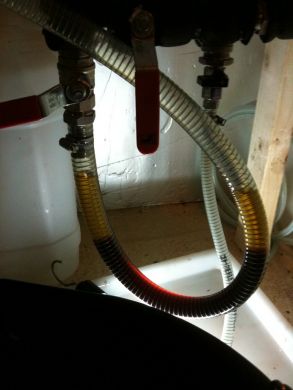
Shown Below: Glycerol and Biodiesel in drain off hose, you can see the enormous difference in the colour of the two liquids, Glycerol is dark brown, Biodiesel is light amber. Also note at this stage prior to water washing, the Biodiesel is clear. After water washing, it will go cloudy, this is because Biodiesel is hydroscopic and absorbs up to around 5% water, Biodiesel with a high water content will be cloudy in appearance
10. Drain off Glycrol
After approximately 15-30 minutes of settling, you will have settled out the majority of the Glycerol, this then needs to be drained off via the tap in the bottom of the Conical Tank. Glycerol is very dark in colour, almost black (see image above), and is easily distinguishable from the lighter Biodiesel at the top of the tank. Glycerol must be drained whilst the mixture is still hot (40 celcius ish) before it thickens at the bottom of the tank blocking your outlet pipe work. After the first drain it can help to switch the pump back on, or use a stirrer to agitate the mix and lift Glycerol from the tank walls, to ensure that you remove as much as possible via the drain valve
At this stage if you require biodiesel of a very high quality, then it is worth performing the "Ester Test, AKA 3/27 Test" see note 13. Below. If you find you have a percentage of unreacted oil (most likely when using the "Single Stage Base Reaction" then this can be addressed at this stage to try and attain the required quality. Take 1g of catalyst, and add to 35ml of Methanol, per 1 Litre of biodiesel in the tank, mix this in and circulate as normal. Repeat step above, but you may find that little or no additional glycerol actually settles out despite following Ester Tests proving further conversion, this will be purged during the washing process
Spent Glycerol has a small value in that it contains Glycerine, which is an expensive commodity, however you are unlikely to find anyone willing to pay for it, so usually it is disposed of, or, turned into Hand Soap. To produce Hand Soap the catalyst must be Sodium Hydroxide, and a small amount of additional sodium hydroxide is added to the Glycerol along with scent, the mixture is then left in the sun to evaporate off, and is then cut into bars. If the catalyst is Potassium Hydroxide this will create liquid soap, rather than solid soap
11. Wash Bio Diesel
What you are left with now is 'Raw', or 'Crude' Bio Diesel. Crude Bio Diesel is almost clean, but contains traces of Methanol, Hydroxide, Soap, Glycerol and possibly Water, and needs to go through a process called 'Washing'
Washing is practised in two main forms, Water Mist Washing (11.a) or Dry Washing (11.c)
11.a) - Water Mist Washing - The lowest cost method of washing biodiesel is by Water Washing, as water will remove catalyst, methanol, soaps, and, as a result of removal of methanol, glycerol from the mixture, sometimes this will be enough to gain the desired purity of fuel, and even if you choose to dry wash afterwards, it will greatly extend the life of expensive Dry Wash Media. Water Washing involves Pumping water at high pressure through an Atomiser, creating tiny water droplets which sink through the Crude Bio Diesel collecting impurities on the way. Mist washing will remove Saturated Methanol and Soap, and this is drained away until the misting water becomes clear, indicating that there is no soap or other water soluable contaminants left. The downside of this is that Bio Diesel is slightly Hydroscopic, and therefore absorbs some of the Water (around 5% by volume of the biodiesel), which then needs to be removed by further Bubble Drying. Mist washing can be made easier by using an Emulsion Breaker additive in the water, this helps to break the emulsion of the water and oil. The Emulsion Breaker needs to be added to water pre-heated to 40 C, then Sprayed onto the Biodiesel at 40 C for it to be most effective. After misting the biodiesel with about 50% water by volume of the oil, the water will settle and should be drained through the bottom tap. Repeat this misting and draining until the wash water is no longer cloudy. If you cannot wait for all of yor water to settle out, then water wash until the water is clear, then reheat and bubble dry the remaining water out of the mix, bubbling will take around an hour to dry the fuel with a good sized workshop air compressor (24 Litre or larger)
Breaking an Emulsion - Sometimes if your titration was not accurate and excessive caustic soda is used, the settling of water will not happen quickly, the mix will present itself as a thick creamy substance like yogurt, this is an emulsified mixture of soap, water and biodiesel. The way to force this to separate is by correcting the PH level. Dip a piece of PH paper into the tank and compare the reading to the scale, from our own experience the PH will be high, around 9 - Alkaline. To correct the PH to 7 we need to add an Acid, and Vinegar is the perfect substance to use, it is also cheap. Keep adding vinegar whilst circulating the mixture with the pump, and keep taking PH readings, once the PH has been corrected to 7, switch off the pump and leave to settle, the mixture will separate over around 24-48 hours. The other way of correcting PH would be to quench with copious amounts of water, but this of course wastes water when only a drop of vinegar will have the same effect
This method can also be performed more scientifically PRIOR TO ADDING ANY WASH WATER by creating a wash water with a PH to neutralise the PH of the crude biodiesel - for example if your biodiesel measures PH9, then create a wash water of equal volume to the oil, with a PH of 5 (by adding vinegar to water) - the same number of points (in this case 2) the other side of Neutral. Adding these two liquids together should result in the whole mixture becoming PH7, and the separation of water from oil to conclude normally
Shown Below - 2 samples of the same emulsion - left sample, corrected from PH 9 to PH 7 using vinegar, right sample has not been corrected. Both samples had settled for 24 hours before photos were taken

Sometimes Water Washing is not possible due to properties being on Small Septic Tanks, and thus the possibly caustic or acidic soaps (check with PH Paper) could adversely affect the microbial activity in the tanks, therefore, if there is no means of otherwise disposing of the caustic waste water, then dry washing is the only practical method
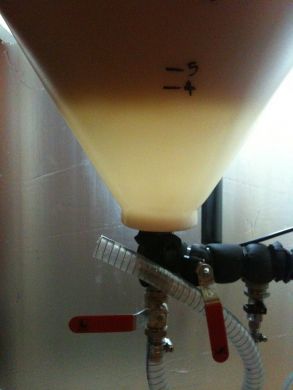
Shown Below: Water settles through the biodiesel immediately at 40c+, this tank is still being washed with a fogger as this picture was taken. The less defined layer at the interface is cream coloured soap, which is floating on the water, between the water and the biodiesel
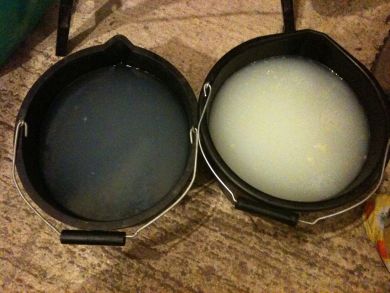
Shown Below: Difference in colour (soap content) from wash 1 to wash 2, the more washes, the cleaner the wash water becomes. Cream coloured clumps and bubbles on the surface of whiter water are soap, the more water your fuel has in it to begin with, the more soap will be created, so it is desirable to remove as much water as possible from your UCO
11.b) - Bubble Dry #2 - To Drive off Water -If you choose to water wash your Biodiesel, then following this you will need to Bubble Dry the Biodiesel again, to drive off up to 5% water which will have been absorbed by the Biodiesel (and causing it to have gone cloudy, like scrumpy cider). Follow instruction 8, the same as for driving off Methanol
For advanced producers, to eliminate atmospheric moisture from entering the system, we recommend use of Activated Alumina Spheres in a Stainless Steel Housing.
11.c) - Dry Washing
Dry Wash Options;
It is important to note that dry wash media is not designed for bulk removal of contaminants, only removal of TRACES of contaminants. Generally speaking, all dry wash media options can only absorb contamination at levels of up to 2% by volume of the biodiesel, with optimum performance levels around 0.5%. If you have a batch of crude biodiesel that you have produced using Phenolphthalein as a titration indicator, and not bubbled out the saturated unused methanol, then your contamination levels could be enormous (10-15%) and will destroy the dry wash media in no time, or the media will have little or no effect
Reducing the amount of contamination prior to dry washing can be achieved by two simple steps - firstly, once you are used to titrating with Phenolphthalein, upgrade to Bromothymol Blue - this will give you a much more accurate titration result, reducing the level of soap produced and unused catalyst remaining after transesterifcation. Secondly, bubble off the saturated unused methanol with an air pump - See Section 8 - Bubble Dry #1
Ecopure (Hardwood Sawdust Based)
Ecopure will remove trace soap, trace glycerol, trace catalysts, trace methanol, trace water
You will need to remove all methanol (down to less than 2% by volume) before putting through the ecopure as it will not remove methanol effectively, this can be done by bubbling. Passing excessive methanol through the media will render it useless in very little time
1kg of ecopure will clean 300-600 litres of biodiesel providing the min/max levels of contamination are observed
(Ion-Exchange Resin)
Ion Exchange Resin will remove trace soap, trace glycerol, trace catalysts, trace methanol, trace water
You will need to remove the bulk of any methanol present before putting through the resin as it will rapidly exhaust the media, this can be done by bubbling
1kg of Ion Exchange Resin will hold 1KG of contaminants
The most effective single pass dry wash media is Ion Exchange Resin, deployed in a Pressure Vessel, or 'Resin Tower'. Ion Exchange Resin should be deployed in a tower of 5:1 Height:Diameter ratio, with a recommended minimum bed depth of 610mm, allowing 50% for vertical expansion, this would point toward any tower with a height of 48 inches, though we find most customers use 0735 or 0844 towers due to the high cost of sufficient resin to load the bigger 0948 tower. The tower can be fed at a rate of 2 litres-per-hour, per 1 Litre of resin it contains, so for example, the 0948 tower, holding 22 litres of Ion Exchange Resin can be fed at 44 litres-per-hour. The only way of attaining EN standard on home brew Bio Diesel is by Water Washing, or using Ion Exchange Resin. To feed the tower we recommend using a quiet running centrifugal pump with approximately 3.5 Bar of outlet pressure.
If you are able to Water Wash, and choose to also Dry Wash afterwards, then the much lower cost 'Eco2pure' (a natural, oak sawdust based dry wash media) will be adequate, instead of Purolite PD206. Eco2pure will not remove saturated methanol, but this will have been removed in the Water Washing process, and so this property is not required. Eco2pure can also be deployed in a standard Pressure Vessel, but the vessel can be filled completely as Eco2pure does not expand as much as Ion Exchange Resin, and so a small vessel can be used
12. Polish Bio Diesel
Polishing is simply the final process to clean the fuel of any undesirable contaminants such as moisture or dirt.
As long as the processes above have been followed then your fuel will probably be of a quality high enough to simply pass through a 1 Micron Particle Filter and then straight into your vehicle
If you wish to invest in a professional polishing device which will also remove traces of water, should there be any, then we recommend an Oilybits Polishing Pot.
13. Test Biodiesel
There are a few basic tests which can be performed to test Biodiesel Quality.
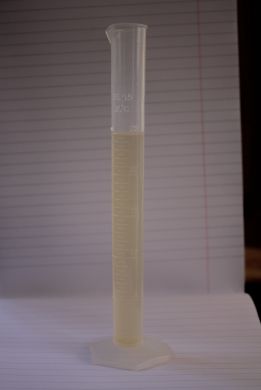
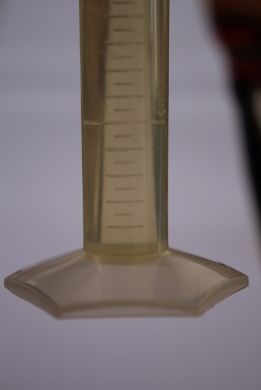
'3/27' Test, or 'Ester' Test - This test is to check for Conversion Rate, and is done using a "Measuring Cylinder", ideally a cylinder of 100ml capacity should be used. Add 1 part Biodiesel, and 9 parts Methanol. If using a 100ml cylinder then you would have used 10ml Biodiesel and 90ml Methanol, if after adding Methanol you are left with 1ml of Vegetable Oil in the bottom, then the Biodiesel is 10% Un-converted (what remains is 10% of the Biodiesel added to begin with). To achieve EN14214 the Biodiesel needs to be 96% converted, you will only achieve 96% conversion using a 'Two Stage Base' or 'Acid-Base' reaction. 'Single Stage Base' will never achieve more than 90% conversion.
Shown below, a measuring cylinder which has been filled with 2.5ml biodiesel and 22.5ml methanol - this is the perfect sample, absolute zero fallout, 100% conversion.
Shake Test - This test is to check for presence or water and / or soap. Using a screw cap clear glass jam jar, add roughly 50% water, and 50% biodiesel, leaving a small amount of airspace (volumes not critical), screw the cap on and swirl the jar around (do not actually shake it, like the name suggests). If the water goes cloudy this is either soap or methanol. To find out which, get another sample of Biodiesel, heat in a pan to 100c until all vapor stops coming off of it. Allow to cool and perform the test again, if the water goes cloudy, then the contamination is soap, the fuel needs to be re-washed. If the water stays clear then the contamination was methanol, the fuel needs to be re-dried.